News
News from the lab
From sunny Spain to Belgium, Paula Otero joins the team as our new postdoc. Welcome to the lab, Paula!
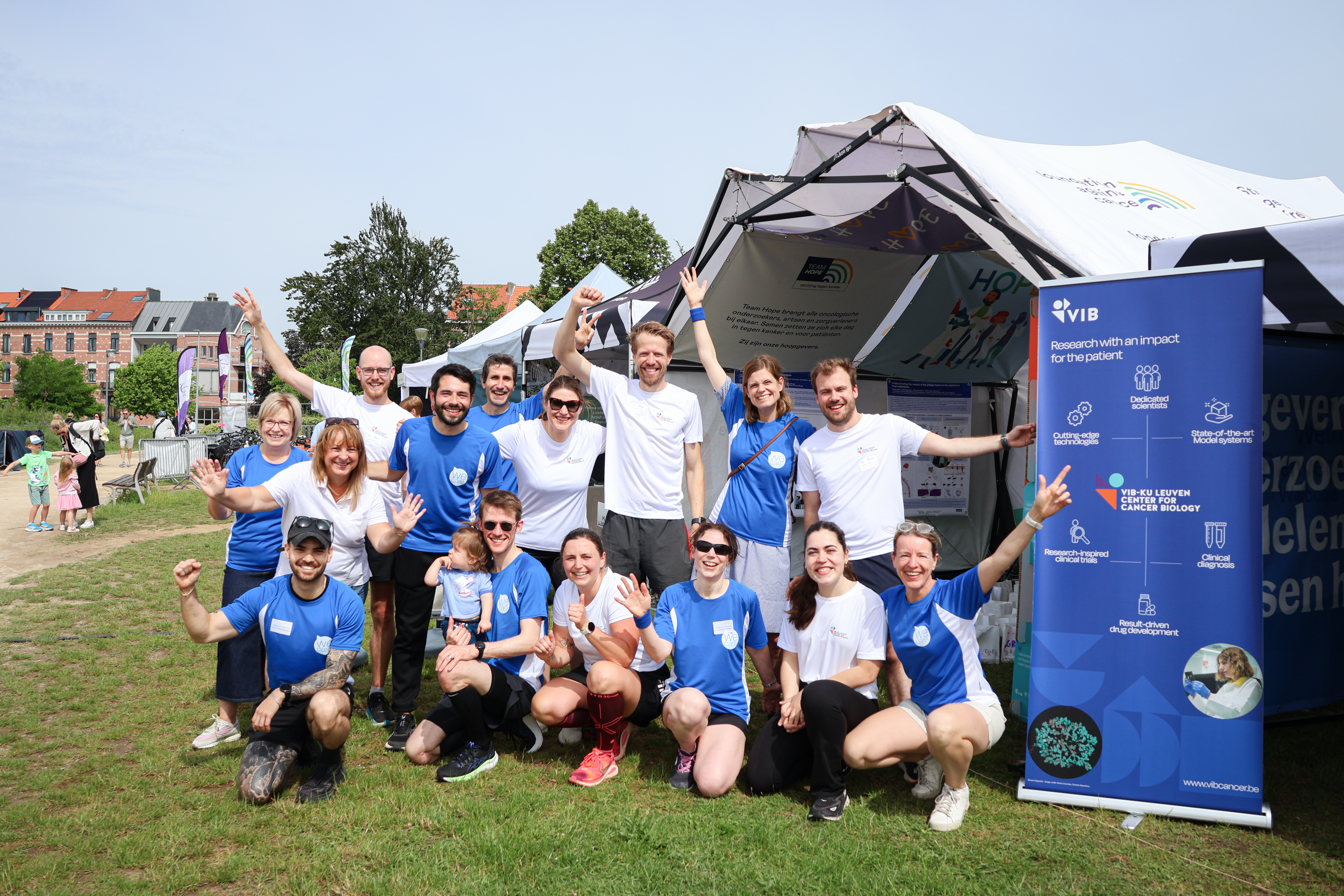
The Demeulemeester Lab proudly participated in Levensloop Leuven, joining colleagues, patients, and supporters in this inspiring event to raise awareness and funds for cancer research. Together, we celebrated community, resilience, and our shared commitment to improving cancer care.
Luuk Harbers joins the team as a staff scientist! A small but very exciting jump from his previous position with the CCBs Bioinformatics Expertise Unit.
Congratulations to Alexander Stein! He has been awarded a F.R.S.-FNRS postdoctoral fellowship for his project to model the spatial interplay between genome and transcriptome evolution during tumour growth and recurrence.
Catho Colson joins the lab as a shared MD PhD student with the team of prof. dr Rik Schrijvers. Exciting work on somatic mosaicism in hematoinflammation!
Marios Eftychiou is awarded an FWO PhD Fellowship fundamental research for his work on bridging genotype and phenotype by machine Learning for single-molecule multi-omic sequencing. Congratulations, Marios!
Ana-Lucia Rocha Iraizos officially joins the team. Co-supervised with colleagues Jan Cools, Daan Dierickx & Marlies Vanden Bempt, she is diving into the evolution of post-transplant lymphomas.
Willem Roosens’ review “Emerging Insights into Mosaic Errors of Immunity” is published in Trends in Immunology.
The first preprint from the lab is out! Say hello to SPLONGGET, our very own approach for Single-cell Profiling by LONG-read sequencing of Genome, Epigenome, and Transcriptome (https://doi.org/10.1101/2025.09.08.674950). This work has already led to several invited lectures, conference prizes, and a recent joint webinar with 10X Genomics and Oxford Nanopore Technologies.
Our collaborative paper with TRACERx on how DNA methylation cooperates with genomic alterations during non-small cell lung cancer evolution, is finally out in Nature Genetics. Congratulations to all co-authors!
Our collaborative paper “Best practices and tools in R and Python for statistical processing and visualization of lipidomics and metabolomics data.” is out in Nature Communications. Thank you, Ruben and Marios for contributing to this valuable effort from the Swinnen and Holčapek labs.
Our VIB Grand Challenges project COMPASS –Comprehensive Omics Informs Precision Action and Diagnosis in Sarcoma– has been selected! Through this consortium effort, we aim to make a big impact for sarcoma researchers, clinicians and patients.
Laurens Lambrechts has been awarded postdoctoral fellowships by both the FWO as well as the Foundation against Cancer. Unprecedented, massive congratulations!
Alexander Stein joins our ranks as a post-doctoral fellow, shared with the Maxime Tarabichi lab at IRIBHM/ULB in Brussels. Welcome, Alex!
Robert Forsyth is granted a one-year doctoral fellowship from the Belgian American Educational Foundation. Whoop, congratulations!
With the Amant team, we’ve been selected by the Fund for Translational Biomedical Research for our work exploring mutational persistence in children prenatally exposed to chemotherapy.
Both of our Foundation against Cancer (STK) projects will be funded as well! With clinical collaborator prof. dr Isabelle Vanden Bempt, we will be putting in place advanced genomics for sarcoma diagnosis and care (AGENDAS). With colleagues from the team of prof. dr. Frédéric Amant, we will explore whether treating pregnant cancer patients with chemotherapy causes a persistent mutagenic imprint in the offsprings’ blood (IMPRINT).
Both of our FWO research projects have been selected for funding! Over the next four years we will be using long-read multiomics to reveals the evolution and heterogeneity of genomically complex sarcomas. In addition, with the team of prof. dr. Rik Schrijvers (UZ/KU Leuven), we will be exploring the role of somatic mosaicism in hematoinflammation.
VIB.AI – the new VIB Center for AI & Computational Biology kicks off with our lab being officially co-affiliated! Join us at the inaugural symposium as well as at the many activities which are to follow over the coming years.
Alexandra Pančíková has won an FWO PhD Fellowship fundamental research! She will be working to integrate long read genome sequencing and single-cell multi-omics to identify genetic variation underlying Parkinson’s disease (co-promoter prof. dr. Stein Aerts)
Welcome, Robert Forsyth, to the lab After his Bioinformatics MSc thesis on evolution and heterogeneity in sarcoma, he’ll be driving the lab’s efforts to bring state-of-the-art long-read multiomics into the clinic for genetic diagnosis and research.
Laurens Lambrechts joins the lab as a postdoc to explore multimodal transcriptome profiling in sarcoma. Welcome, Laurens!
Our application for FWO Large-Scale Research Infrastructure funding (“T2T-Biology”) has been approved. We get to install the first highly accurate PacBio Revio long-read sequencer in Belgium in the Leuven Genomics and VIB Nucleomics Cores.
Welcome to Marios Eftychiou as the lab’s third PhD student. Marios will extend the work he did during his MSc thesis in Statistics and AI to develop deep learning approaches for extracting insights into genomic variation from multiomic single-molecule data.
Congratulations to Alexandra Pančíková and Ruben Cools for winning one-year doctoral fellowships from KU Leuven and Stand up to Cancer, respectively.
Welcome to the one and only Joris Vande Velde as our new Lab Manager.
Alexandra Pančíková and Ruben Cools join the lab as the first two PhD students! Alex will build on her master thesis work with us and prof. dr. Stein Aerts to integrate multiomic long-read and single-cell sequencing to better understand the role of regulatory variation in brain during health and disease. Ruben will take a deep dive into the evolution and heterogeneity of rare peripheral T-cell lymphomas.
We’re happy to announce our KU Leuven C1-grant application with the groups of Stein Aerts, Diether Lambrechts, Yves Moreau, Joris Vermeesch and Thierry Voet, was approved for funding. The project, which is titled “SymBioSys: Computationally mapping genomic heterogeneity from long read sequencing data” will provide EUR1.587.839 in funding from 2022-2026 to support several PhD students and postdocs working on mining and integrating single-molecule sequencing data to answer various research questions in embryogenesis, neurodevelopment, ageing and cancer.
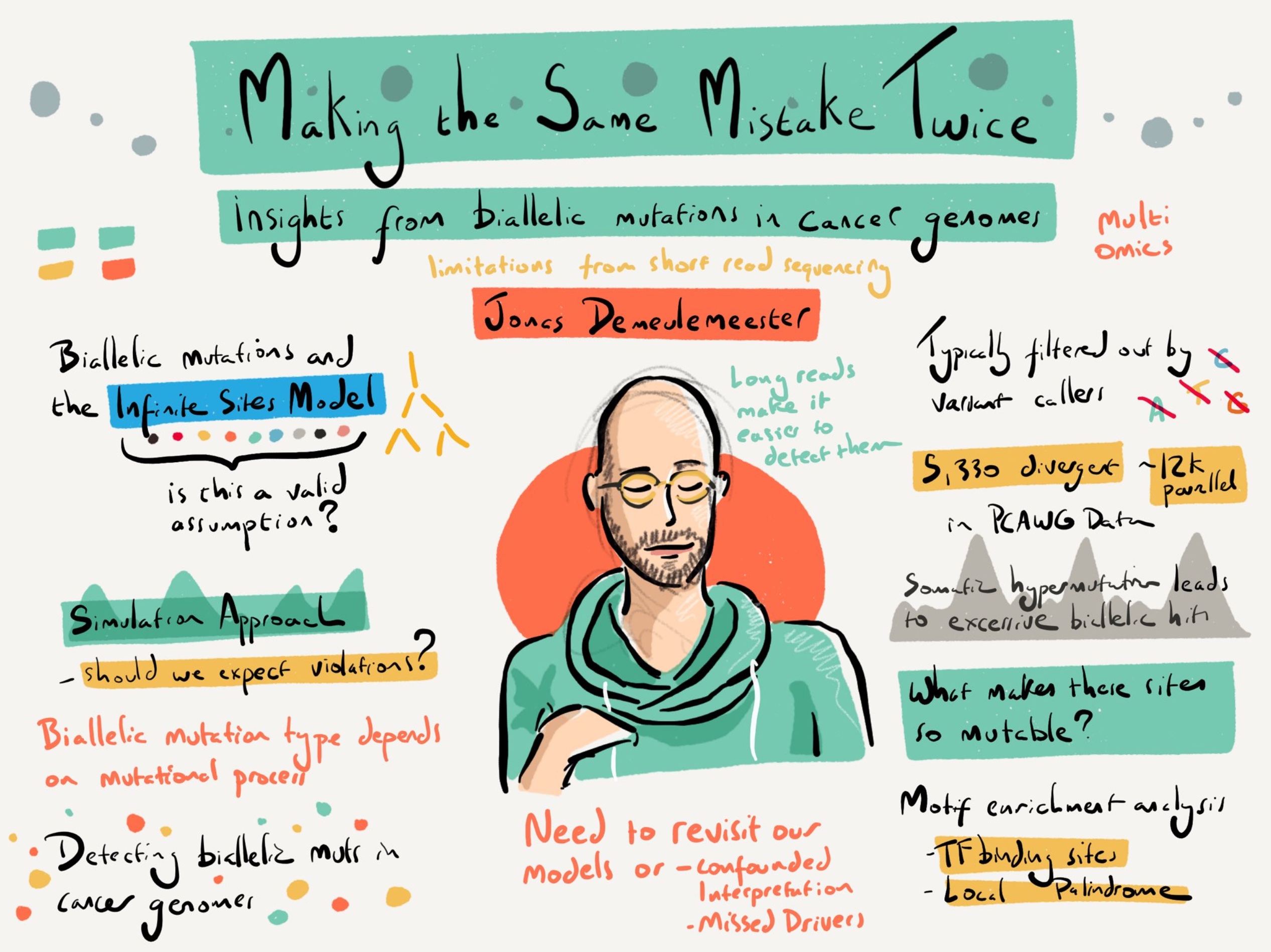
A large scale study of 2658 tumors - by KULeuven in collaboration with the Francis Crick Institute - appeared in Nature Genetics:
The infinite sites model of molecular evolution posits that every position in the genome is mutated at most once. By restricting the number of possible mutation histories, haplotypes and alleles, it forms a cornerstone of tumor phylogenetic analysis and is often implied when calling, phasing and interpreting variants or studying the mutational landscape as a whole. Here we identify 18,295 biallelic mutations, where the same base is mutated independently on both parental copies, in 559 (21%) bulk sequencing samples from the Pan-Cancer Analysis of Whole Genomes study. Biallelic mutations reveal ultraviolet light damage hotspots at E26 transformation-specific (ETS) and nuclear factor of activated T cells (NFAT) binding sites, and hypermutable motifs in POLE-mutant and other cancers. We formulate recommendations for variant calling and provide frameworks to model and detect biallelic mutations. These results highlight the need for accurate models of mutation rates and tumor evolution, as well as their inference from sequencing data.
Read more on KULeuven.be or read the article in Nature Genetics